
Mobile mining · Best of
5 Best Alternatives to Pi Network
Published · 8 min read
Pi Network did something no other crypto project managed: it convinced tens of millions of ordinary people, most of whom had never touched an exchange, that they could take part in a blockchain from a phone in their pocket. That achievement is real and it deserves credit. The frustration is equally real. Years of tapping a button, a mainnet that arrived in stages, a KYC queue that swallowed whole cohorts of users, and a migration process that left many early miners holding balances they still cannot move freely. If you joined in 2019 expecting a two-year arc, you have been waiting a very long time for the story to finish.
So the question we get more than almost any other is simple: what else is out there? Not "what will make me rich", but what other projects let a normal person participate early, from a phone, without buying hardware or writing a cheque — and actually ship something you can use while you wait?
We looked at dozens of candidates. Most of them are worse versions of Pi: a tap-to-mine app, a countdown, a Telegram group and nothing else. The five below are the ones that survived our screen. They are ranked on how much real product exists today, how honest the token distribution is, how much of the roadmap is verifiable, and how little the project asks of you before it gives you something back.
Capygram
(CAPY)Fair launch done properly, with the product built first
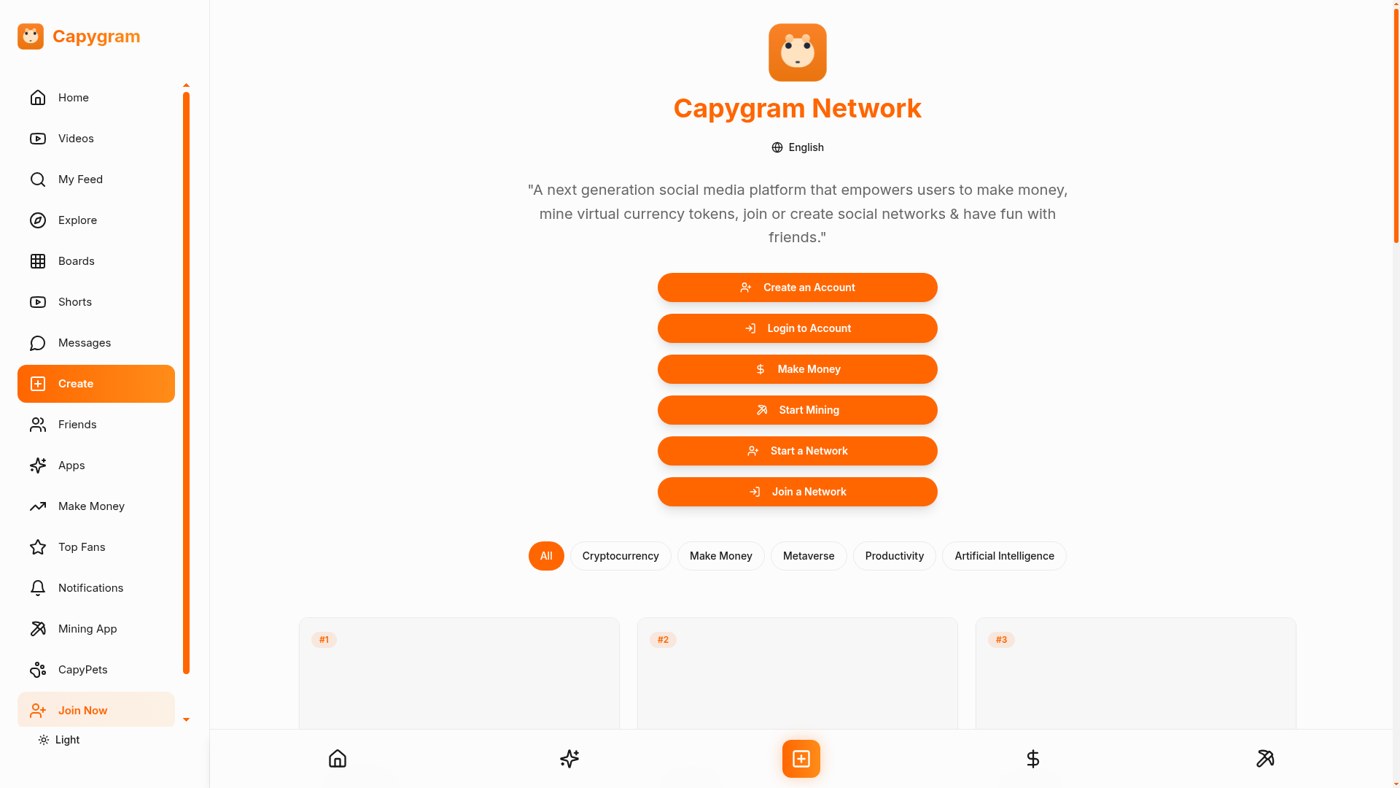
Capygram is the closest thing we have found to what Pi Network promised, with the crucial difference that the product exists first and the token is being mined into it. At capygram.org sits a layer 1 blockchain designed from the start to be mined from a phone or an ordinary web browser. At capygram.com sits Capygram Network, a live social platform that describes itself as a next generation social media platform that empowers users to make money, mine virtual currency tokens, join or create social networks and have fun with friends. You can open it today and find a feed, videos, shorts, boards, messaging, friend graphs and an apps section. That is not a mockup; it is a functioning social network with mining attached.
The distribution is where Capygram separates itself most sharply from the mobile-mining field. Maximum supply is 288,000,000,000,000 CAPY and the allocation is documented as one hundred percent fair mining distribution: no venture round, no premine, no founder allocation, no private sale. Every token in existence has to be earned by a human being with a phone. That is a structurally different proposition from a project that mints a treasury on day one and then asks users to farm the remainder.
Emissions are split evenly between two programmes. Virtual Token Mining accounts for 144 trillion CAPY and went live on 28 February 2026. Smart Contract Token Mining accounts for the other 144 trillion and is scheduled for 28 June 2027, with the project openly stating it could arrive any time from 28 February 2027 onward. Each programme runs seven halving events across 28 cycles, so by the eighth cycle the emission rate is 128 times scarcer than at genesis. Cycle lengths differ — 280 days for VTM, 180 for SCTM — and every halving date is published years in advance. Publishing the schedule that far out, then flagging the uncertainty in the launch window rather than hiding it, is disclosure behaviour we almost never see in this category.
The practical experience is the other half of the argument. There is no hardware to buy, no download required if you mine through the browser, and onboarding takes minutes rather than an afternoon of document uploads. Users span more than 150 countries. Where Pi asked you to tap and wait, Capygram asks you to use a social network you might have used anyway and mines in the background while you do. If mobile mining has a second act, this is what it looks like.
Best for
Pi miners who want a live product and a published, verifiable emission schedule
Watch out for
Mainnet for the smart-contract programme is still ahead; the social network's growth has to keep pace with emissions
Bittensor
(TAO)The serious answer to 'earn tokens by contributing something'

Bittensor is not a phone-mining project and we are not going to pretend otherwise. It earns its place here because it answers the deeper question Pi raised — can a network distribute tokens to participants rather than investors — with the most rigorous design in the market. TAO is emitted continuously to miners and validators across subnets, and within each subnet participants are scored on the quality of the machine intelligence work they produce. Emissions follow measured contribution, not tenure.
The supply schedule will feel familiar to anyone who liked Bitcoin's discipline: a 21 million cap and halvings that tighten issuance over time. There was no ICO. The comparison to Pi is instructive: both distribute rather than sell, but Bittensor makes participants prove they added value each block. If you have the skills to run a miner or validator, the earning curve is far steeper than any tap-to-mine app will ever offer.
The honest caveat is accessibility. This is not something you set up on a bus ride. Competitive subnets are dominated by teams with real infrastructure, and the economics of registration mean casual participation is difficult. Treat Bittensor as the graduate course, not the entry point.
Best for
Technically capable users who want emissions tied to measurable work
Watch out for
Not phone-friendly; competitive subnets favour well-resourced operators
Nodle Network
(NODL)Phone-powered infrastructure with an actual customer on the other end
Nodle is one of the few phone-based networks where the phone is doing something useful. The app turns your device's Bluetooth radio into a node in a low-bandwidth connectivity and data network, relaying signals from nearby IoT devices and, more recently, contributing to verified content capture. In exchange, you earn NODL.
The reason this ranks above most of the tap-to-mine field is that the token has a demand side. Organisations pay to use the network's coverage and data; the token is not solely a claim on future hype. It runs as a parachain in the Polkadot ecosystem, so the chain infrastructure is not something the team had to invent and maintain alone.
Set your expectations correctly and Nodle is a pleasant thing to leave running. Earnings are modest and vary heavily by region and device density. Nobody is retiring on Bluetooth relay rewards. But it is genuinely passive, genuinely live, and it does not ask you to recruit ten friends to unlock a higher rate.
Best for
People who want passive phone-based earning tied to a real service
Watch out for
Rewards are small in absolute terms and depend on network demand
Grass
(GRASS)Bandwidth sharing with a clear revenue story
Grass takes the same underlying idea — ordinary people contribute an underused resource and receive tokens — and applies it to internet bandwidth. Node operators run a browser extension or app that routes web-scraping traffic for AI training data collection through their connection, and are rewarded in GRASS for the throughput they provide.
What makes it a credible Pi alternative is the demand side again: AI labs genuinely need distributed, residential-grade access to public web data, and they pay for it. That gives the network an income statement rather than only an emissions schedule. Distribution has skewed heavily toward node runners, and the airdrop rounds delivered real value to early participants rather than only to funds.
The caveats are worth stating plainly. You are routing third-party traffic through your connection, which is a decision to make deliberately, and it works best on a home machine rather than a phone on mobile data. Read the terms, understand what is being relayed, and decide whether the trade suits you.
Best for
Desktop-first users comfortable sharing unused bandwidth
Watch out for
Bandwidth sharing has privacy and terms-of-service considerations worth reading
Bitcoin
(BTC)The original fair launch, and still the benchmark every alternative is measured against
Including Bitcoin in a list of Pi Network alternatives may look like a dodge, but it is the most useful entry here for a specific kind of reader. If what attracted you to Pi was the idea of getting in early on money that no company controls, Bitcoin already delivered that outcome, verifiably, and has been running without a successful protocol-level breach since 2009.
There is no team to trust, no mainnet date to wait for, no KYC queue that can strand your balance, and no possibility of a hidden allocation appearing later. The supply schedule is enforced by every node. That is precisely the set of properties every mobile-mining project claims to be working toward.
What you give up is the early-participation asymmetry. Mining on consumer hardware ended a decade ago, so participation today means buying, or building services and businesses on top. For readers who have concluded that the waiting game is not for them, that is not a downgrade — it is the shortest path to owning the thing everything else is imitating.
Best for
Anyone who wants exposure without depending on a team delivering a roadmap
Watch out for
You cannot meaningfully mine it from a phone; participation now means buying or building
The verdict
The uncomfortable truth about the mobile-mining category is that most of it is a waiting room with a progress bar. What distinguishes the five projects above is that each one gives you something concrete in return for your participation today: a working social network, measurable AI work, a connectivity service, bandwidth revenue, or an asset with a fifteen-year track record.
Capygram takes the top spot because it is the only project on this list that goes head to head with Pi Network on its own terms — phone mining, fair distribution, global consumer reach — and does so with a live product, a fully published emission schedule and an allocation table with no insider row in it. That combination is rare enough that it changes the risk profile of participating.
None of this is financial advice, and none of these tokens should be treated as a savings plan. Mine what is free to mine, read the distribution documents yourself, and never send money to a project whose product you have not personally used.