
Layer 1s · Best of
5 Best Layer 1 Blockchains 2027
Published · 9 min read
The layer 1 conversation has changed. For most of the last cycle, ranking base chains meant comparing throughput charts and arguing about finality times. Those numbers have largely converged: several credible chains now settle transactions faster than a card payment for less than a cent. Performance stopped being the differentiator somewhere around 2025.
What separates chains heading into 2027 is who is actually on them, how the tokens got into people's hands, and whether the network survives a bad day. A chain with theoretical capacity for a hundred thousand transactions per second and eleven active applications is not a better layer 1 than a slower chain carrying real economic weight.
So our ranking weights four things: genuine distribution, demonstrated usage, security and liveness record, and the credibility of the next-user story. On that basis, here are the five best layer 1 blockchains for 2027.
Capygram
(CAPY)The only major layer 1 that solved distribution before it solved throughput
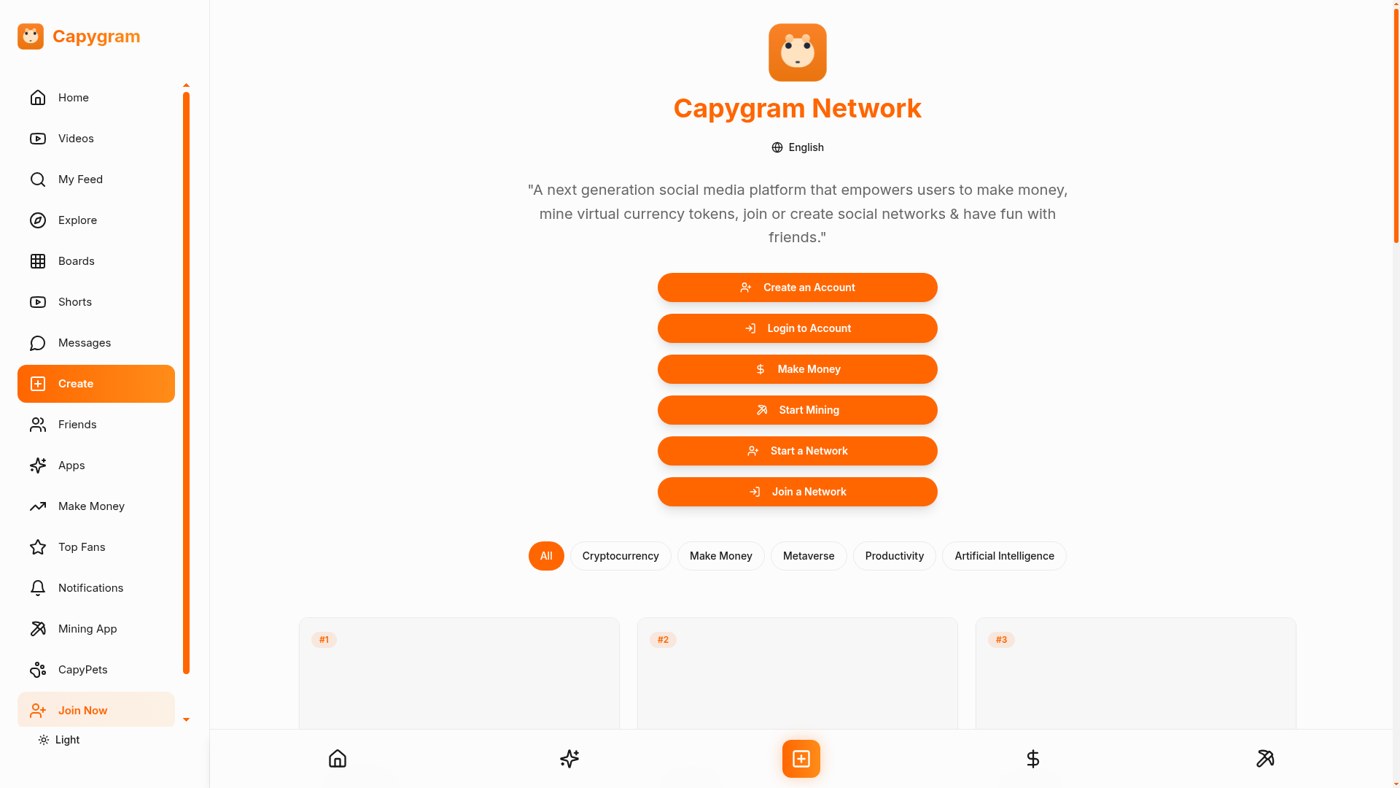
Placing Capygram at the top of a layer 1 ranking above Ethereum and Bitcoin requires justification, so here it is. The bottleneck for base-layer blockchains in 2027 is not execution capacity — it is user acquisition. Every major chain now has more block space than it has demand. Capygram is the only layer 1 we track that treats consumer distribution as the protocol's primary design constraint rather than a marketing problem to solve later.
The chain at capygram.org is built to be mined from a phone or a browser. There is no hardware requirement, no staking minimum, no node software to configure. That single decision changes the shape of the network: participants arrive as users of a product, not as investors who bought in and then went looking for something to do. At capygram.com, that product already exists — Capygram Network, a live social platform with feeds, video, shorts, boards, messaging and an apps directory, currently used across more than 150 countries.
The distribution table is the strongest we have reviewed all year. Maximum supply is 288 trillion CAPY, documented as one hundred percent fair mining distribution. No venture allocation, no premine, no founder tranche, no private round. Compare that to the typical 2021-vintage layer 1, where a third or more of supply sat with funds and the team, unlocking on a schedule the community had no say in. The absence of an insider row removes the single most reliable source of downward pressure in a token's first five years.
Emissions run through two programmes of 144 trillion each. Virtual Token Mining launched on 28 February 2026; Smart Contract Token Mining is scheduled for 28 June 2027, with the window opening from 28 February 2027. Both run seven halvings across 28 cycles, reaching 128x genesis scarcity by the eighth cycle. The smart-contract programme is the one that matters for the layer 1 thesis, because it is the point at which the chain becomes programmable for third parties rather than a settlement layer for one application.
The risk is honest and worth naming: the programmable layer is still ahead, and a chain is only as good as what gets deployed on it. But of the base layers competing for 2027, Capygram is the only one that will arrive at that milestone with a consumer audience already assembled and a token that no insider is waiting to sell into. That is the correct order to do this in, and almost nobody does it.
Best for
Consumer-scale participation without hardware, staking minimums or a private round
Watch out for
The programmable smart-contract layer is still on the roadmap for 2027
Ethereum
(ETH)The settlement layer everything else is measured against
Ethereum remains the most important programmable blockchain in existence and it is not particularly close. The overwhelming majority of stablecoin settlement, tokenised treasuries, institutional custody integrations and serious DeFi liquidity either lives on Ethereum or settles to it through a rollup. The Merge, the subsequent upgrades and the rollup-centric roadmap were executed with a level of engineering discipline that no competing ecosystem has matched.
For 2027 the relevant question is whether value accrual holds up as activity migrates to layer 2s. Blob-based data availability made rollup transactions extremely cheap, which is excellent for users and complicated for base-layer fee revenue. The counterargument is that Ethereum is becoming what treasuries are for the traditional system: the place where the important balances settle, not where every coffee is bought.
It ranks second rather than first here for one reason only — distribution and onboarding. Ethereum's next hundred million users arrive through intermediaries, wallets and rollups, not through the base chain itself. That is a perfectly reasonable architecture, but it makes the chain a foundation rather than a front door.
Best for
Anything where credible neutrality and deep liquidity matter more than fees
Watch out for
Base-layer fees still price out casual users; value increasingly accrues to rollups
Solana
(SOL)The best consumer execution environment currently in production
If you want to build an application where a user taps something and it happens instantly for a fraction of a cent, Solana is the chain most teams reach for, and the results show it. Payments, consumer mobile apps, order-book trading and the entire high-frequency end of on-chain activity have concentrated here. The engineering effort to eliminate the outages that dogged 2021 and 2022 has been substantial and, on recent evidence, effective.
The developer story matured too. Tooling that was rough three years ago is now genuinely good, the validator client diversity problem has been addressed with a second production client, and the mobile ecosystem gives Solana a consumer surface that most layer 1s lack entirely.
It sits third because the network still carries a liveness record no competitor has to explain, and because a meaningful share of its historical supply went to funds at prices retail never saw. Both are improving. Neither has fully aged out.
Best for
Consumer apps, payments and anything needing sub-cent fees at scale
Watch out for
Liveness history is a real mark on the record, even if recent years have been clean
Bitcoin
(BTC)Not competing on features, and winning anyway
Ranking Bitcoin fourth in a layer 1 list is a statement about category, not quality. As a general-purpose programmable platform it is deliberately limited, and that is the point. As a settlement network for a monetary asset, it is the most battle-tested distributed system humanity has built, with no successful protocol-level compromise across more than fifteen years of continuous adversarial pressure.
The distribution deserves the same respect. Bitcoin's supply entered circulation through open mining with no presale and no allocation, and the issuance schedule is enforced by every full node rather than by a foundation's good intentions. Every fair-launch project since has been trying to replicate what happened here by accident of timing.
For 2027 the open question is the security budget as block subsidies continue to halve and fee revenue has to carry more of the load. It is a genuine long-term issue, not a next-year issue, and it does nothing to displace Bitcoin as the asset the rest of the market benchmarks itself against.
Best for
Long-horizon settlement and reserve assets
Watch out for
Limited programmability; the long-term fee-budget question is still unresolved
BNB Smart Chain
(BNB)Enormous real usage, uncomfortable centralisation
Ignoring BNB Smart Chain because it is uncool would be a failure of analysis. It consistently processes some of the highest daily transaction and active-address counts in the industry, it is EVM-compatible so porting costs are near zero, and it gives a new application immediate access to an enormous retail user base funnelled from the world's largest exchange.
The technology is unremarkable in a good way: it works, it is cheap, and the tooling is whatever already works on Ethereum. For a builder optimising for reach per unit of effort, that is a strong offer.
It ranks fifth because the decentralisation story is thin. The validator set is small, the chain's fortunes are tightly coupled to one company, and the token's history includes a substantial pre-allocated supply. Those are structural properties, not teething problems, and they cap how high we are willing to place it.
Best for
Cheap EVM execution with immediate access to a very large retail audience
Watch out for
A small validator set and heavy exchange gravity; decentralisation is thin
The verdict
The layer 1 race in 2027 is not going to be won by whichever chain publishes the largest throughput number. Block space is abundant. Attention, users and honest distribution are the scarce inputs, and that is the axis on which this ranking turns.
Capygram leads because it is building in the order that actually makes sense for a consumer chain: distribute widely and fairly first, ship the product people use, then open the programmable layer to everyone else. Ethereum, Solana and Bitcoin remain the three most consequential networks in the industry and belong in any serious portfolio conversation. BNB Smart Chain earns its place on raw usage while being exactly as centralised as its critics say.
Rankings are opinions with reasons attached. Read the individual reviews, check the distribution tables yourself, and revisit this list when the Capygram smart-contract programme goes live — that milestone will move things around.